Life is difficult, unfairly so. So many times, we all feel cheated. Even when it appears we’ve done the right thing, it’s as if the world itself is fighting against us. As Christians, we should expect this, for we live in the same world that took the greatest man to walk the earth, a man who acted in nothing but love, and treated him with nothing but derision. He is our ideal. In everything we do we strive to emulate him, and yet it’s this ideal that the world hates. We should expect the world to be cruel, and yet, where is God? Is He simply going to allow such injustice? So many times it feels like He is so far from us.
Matthew 27:46 (ESV) reads, “And about the ninth hour Jesus cried out with a loud voice, saying, ‘Eli, Eli, lema sabachthani?’ that is, ‘My God, my God, why have you forsaken me?’” These words exactly mirror those said by King David in the Psalms, “My God, my God, why have you forsaken me?” (Ps. 22:1, ESV). In this psalm, it’s revealed that David, in his cry to God, has predicted Jesus’ crucifixion. Verses 6 through 18 can all be directly applied to Christ and his sacrifice, but most striking is verse 16: “For dogs encompass me; a company of evildoers encircles me; they have pierced my hands and feet.” What at first seems to be a desperate and confused cry suddenly becomes a call to reference this specific psalm, with Jesus as a fulfillment to a prophecy not yet known.
22 I will tell of your name to my brothers;
in the midst of the congregation I will praise you:
23 You who fear the Lord, praise him!
All you offspring of Jacob, glorify him,
and stand in awe of him, all you offspring of Israel!
24 For he has not despised or abhorred
the affliction of the afflicted,
and he has not hidden his face from him,
but has heard, when he cried to him. (Ps 22:22-24, ESV)
After David laments his situation, he transitions into praise. He praises God despite all the hardship, that even amidst his affliction, God has not turned His face away from the one who cries out. He has heard every word, seen every tear fall. This psalm is Jesus’ final act of worship, a song of light even in the darkest pit imaginable, a song of the highest praise.
29 All the prosperous of the earth eat and worship;
before him shall bow all who go down to the dust,
even the one who could not keep himself alive.
30 Posterity shall serve him;
it shall be told of the Lord to the coming generation;
31 they shall come and proclaim his righteousness to a people yet unborn,
that he has done it. (Ps. 22:29-30, ESV)
To the rich, the poor, the dead, and the unborn, David’s final message is that all will worship, that the Lord is sovereign over all. In Jesus’ final moments, before he gives up his spirit (Matt. 27:50), he proclaims that he has done it. He has seen all the affliction of the world, all the evil, all the sin, and taken it on himself. God has not forsaken us, for Jesus himself is his reaction. Even if we should suffer all the way to our graves like many Christians have, we need not worry if God hears us or if he will respond, for the life of Jesus itself is his response. He lived a perfect life, and died on that cross as his judgement on all sin, both the sin we commit and the sin done to us. It is for that reason that we need not worry about the endless sufferings of the world, for we serve a God who lived it with us, who understands us, and who paid for us, that after this life we may be free. That is God’s perfect response, not one of petty temporary intervention, but of eternity. And in that, there is always reason to rejoice.
Marco Conde is a third year at the University of Chicago and Editor-in-Chief of CANA. He is studying economics and creative writing and hopes to be an author one day.
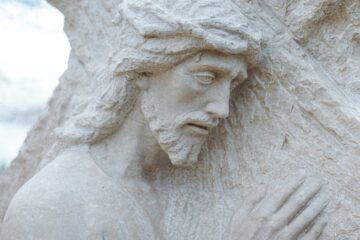
Image credit: “Calvary”, by Pietro Sassi, 1870, Wikimedia Commons



0 Comments